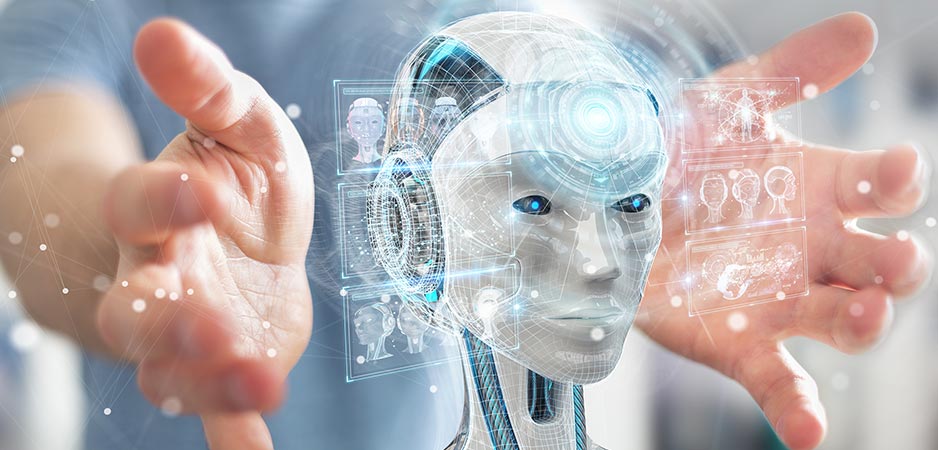
We will be looking at various aspects of self-awareness. This includes the level of consciousness and the location of awareness in your brain. We'll also cover some ethical issues associated with self-aware AI. We'll close with some background on the term "self-modification."
Self-modification
Scientists have been wondering for years when computers will be'self aware'. This stage in evolution, when computers realize that they are things, has been called the Artificial Consciousness, —Machine Consciousness, and ’Synthetic Consciousness. Stephen Hawking also coined the term "Synthetic consciousness", to describe the day when computers can evolve faster than the human mind.
Level of consciousness
Computers become self-aware as they recognize their thoughts and make decisions based upon them. Although some researchers suspect this may be artificial intelligence (AI), the evidence is not conclusive. It remains to be seen whether this will happen and if so, what might it mean for our future.

Computers can have many benefits and have many uses. One example is that an AI can use the ability of a person to feel emotions as a basis for analysing its level of consciousness. Artificial intelligence can learn from the history of consciousness evolution in nature.
Placement of awareness in the brain
Our consciousness is determined by the location of our awareness in the brain. Our consciousness allows us to make decisions and then act on them. Our experience of reality informs our consciousness. Our brains use an expertise system to determine the best actions based on particular circumstances.
You can do this by learning and doing. This process is called self awareness. It involves data gathering, processing and evaluation skills. It is the ability of becoming aware of one's own existence and that around you. This is a part of our psychology.
Ethics of self-aware AI
In this panel discussion, the authors of several books on the ethics of self-aware AI discuss their respective concerns regarding these new technologies. They are Reverend Raul Anthony, Magistra Peggy Nadramia and Magus Peter H. Gilmore.

Although AI and robots are still relatively new fields of applied ethics, there is potential for some exciting areas of ethical thought. The European Group on Ethics of Science and New Technologies (EGEST) has provided a promising overview of ethical issues and begun to make policy recommendations. People interested in ethics will also find the AI HLEG group a useful resource.
FAQ
How will AI affect your job?
AI will eliminate certain jobs. This includes taxi drivers, truck drivers, cashiers, factory workers, and even drivers for taxis.
AI will create new jobs. This includes positions such as data scientists, project managers and product designers, as well as marketing specialists.
AI will simplify current jobs. This applies to accountants, lawyers and doctors as well as teachers, nurses, engineers, and teachers.
AI will make existing jobs more efficient. This applies to salespeople, customer service representatives, call center agents, and other jobs.
What is the current state of the AI sector?
The AI industry is growing at a remarkable rate. By 2020, there will be more than 50 billion connected devices to the internet. This will allow us all to access AI technology on our laptops, tablets, phones, and smartphones.
Businesses will need to change to keep their competitive edge. If they don’t, they run the risk of losing customers and clients to companies who do.
This begs the question: What kind of business model do you think you would use to make these opportunities work for you? You could create a platform that allows users to upload their data and then connect it with others. You might also offer services such as voice recognition or image recognition.
No matter what your decision, it is important to consider how you might position yourself in relation to your competitors. It's not possible to always win but you can win if the cards are right and you continue innovating.
Is there another technology which can compete with AI
Yes, but not yet. Many technologies have been created to solve particular problems. However, none of them can match the speed or accuracy of AI.
What is the role of AI?
An artificial neural network is composed of simple processors known as neurons. Each neuron receives inputs form other neurons and uses mathematical operations to interpret them.
Neurons can be arranged in layers. Each layer has its own function. The first layer receives raw information like images and sounds. Then it passes these on to the next layer, which processes them further. Finally, the last layer generates an output.
Each neuron has an associated weighting value. This value is multiplied with new inputs and added to the total weighted sum of all prior values. If the result exceeds zero, the neuron will activate. It sends a signal down the line telling the next neuron what to do.
This continues until the network's end, when the final results are achieved.
Statistics
- More than 70 percent of users claim they book trips on their phones, review travel tips, and research local landmarks and restaurants. (builtin.com)
- According to the company's website, more than 800 financial firms use AlphaSense, including some Fortune 500 corporations. (builtin.com)
- The company's AI team trained an image recognition model to 85 percent accuracy using billions of public Instagram photos tagged with hashtags. (builtin.com)
- That's as many of us that have been in that AI space would say, it's about 70 or 80 percent of the work. (finra.org)
- In 2019, AI adoption among large companies increased by 47% compared to 2018, according to the latest Artificial IntelligenceIndex report. (marsner.com)
External Links
How To
How to configure Alexa to speak while charging
Alexa, Amazon’s virtual assistant is capable of answering questions, providing information, playing music, controlling smart-home devices and many other functions. It can even hear you as you sleep, all without you having to pick up your smartphone!
Alexa allows you to ask any question. Simply say "Alexa", followed with a question. She'll respond in real-time with spoken responses that are easy to understand. Alexa will also learn and improve over time, which means you'll be able to ask new questions and receive different answers every single time.
You can also control connected devices such as lights, thermostats locks, cameras and more.
Alexa can adjust the temperature or turn off the lights.
Alexa to speak while charging
-
Step 1. Turn on Alexa Device.
-
Open Alexa App. Tap the Menu icon (). Tap Settings.
-
Tap Advanced settings.
-
Select Speech Recognition
-
Select Yes, always listen.
-
Select Yes, only the wake word
-
Select Yes, then use a mic.
-
Select No, do not use a mic.
-
Step 2. Set Up Your Voice Profile.
-
Select a name and describe what you want to say about your voice.
-
Step 3. Step 3.
Followed by a command, say "Alexa".
Ex: Alexa, good morning!
Alexa will respond if she understands your question. For example, John Smith would say "Good Morning!"
Alexa will not reply if she doesn’t understand your request.
-
Step 4. Restart Alexa if Needed.
If necessary, restart your device after making these changes.
Note: If you change the speech recognition language, you may need to restart the device again.